
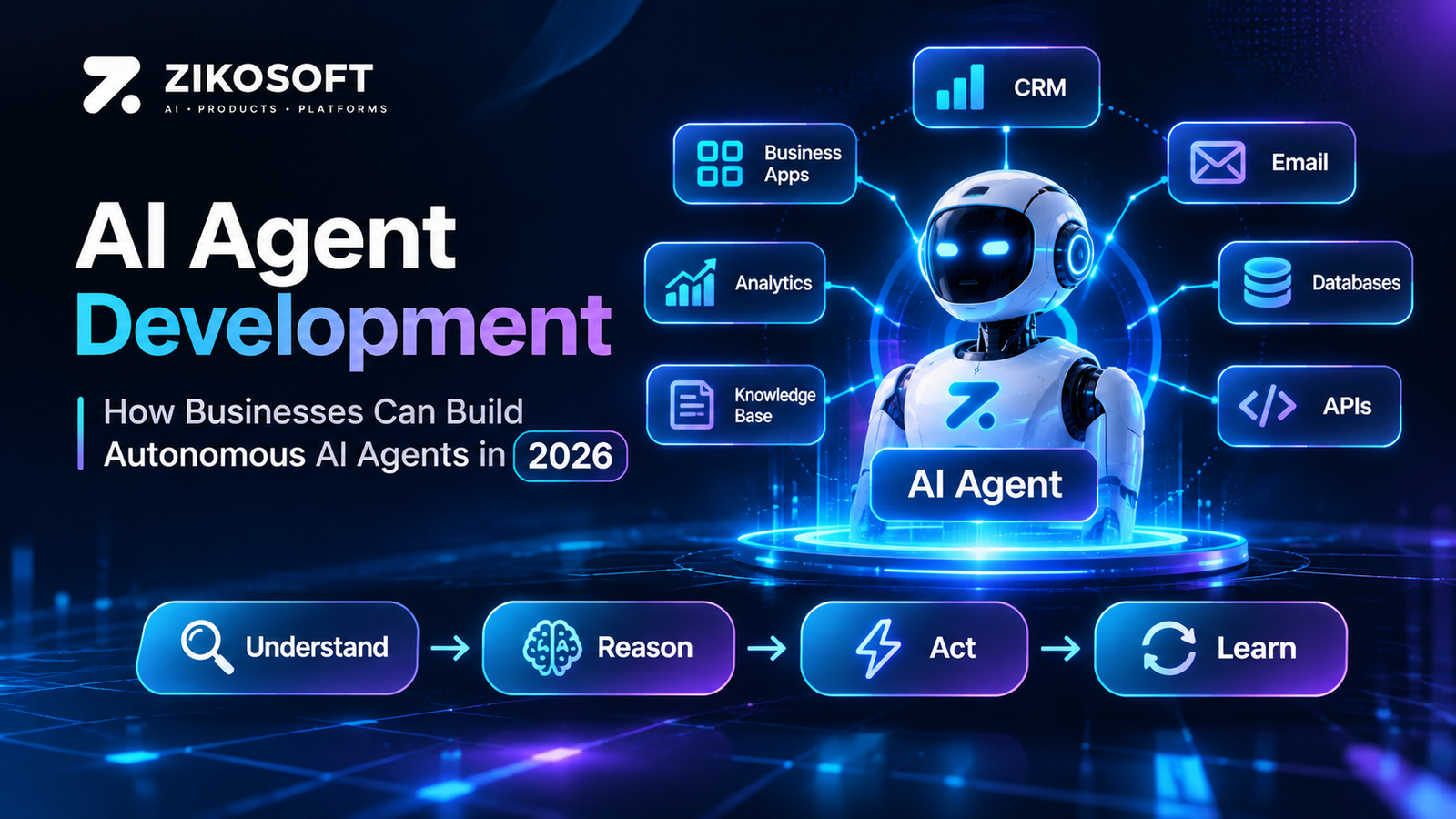
Artificial intelligence is moving beyond simple chatbots and content generation. In 2026, businesses are increasingly exploring autonomous AI agents that can understand objectives, retrieve information, make decisions within defined boundaries, and execute tasks across connected systems.
From automating customer support to managing sales workflows and processing enterprise documents, AI agents offer opportunities to improve productivity, reduce repetitive work, and accelerate business operations.
However, developing reliable AI agents requires more than connecting a large language model (LLM) to an application. Businesses need secure integrations, intelligent orchestration, well-defined workflows, human oversight, and continuous performance evaluation.
In this guide, we explain what AI agent development is, how autonomous AI agents work, the technologies behind them, and how businesses can build production-ready AI agent solutions in 2026.
What Is AI Agent Development?
AI agent development is the process of designing, building, integrating, and deploying intelligent software systems that can pursue defined goals, reason through tasks, use external tools, and execute actions with varying levels of autonomy.
Unlike conventional automation systems that follow predefined instructions, AI agents can dynamically select actions based on available information and the objectives they are given.
For example, a traditional customer support chatbot might answer questions about an order.
An AI agent could potentially:
- Understand a customer’s issue.
- Retrieve order information from a CRM or commerce platform.
- Check delivery status through an API.
- Identify an appropriate resolution.
- Initiate an authorized workflow or request human approval.
- Update the support ticket and communicate the outcome.
This makes AI agent development especially relevant for businesses managing complex workflows across multiple software applications.
The objective is not to eliminate human involvement entirely. Instead, businesses can automate suitable tasks while maintaining appropriate human control over sensitive or consequential decisions.
How Do Autonomous AI Agents Work?
Autonomous AI agents combine language models, contextual information, tools, memory, and workflow orchestration to complete tasks.
A practical AI agent architecture can be understood through four connected stages.
1. Understand: Interpret the Goal
The agent receives an instruction or business objective.
For example:
“Review new customer inquiries, identify high-priority leads, and prepare follow-up actions.”
The AI agent interprets the objective, identifies relevant information, and determines which tools or systems may be needed.
2. Reason: Plan the Next Actions
The agent evaluates available information and decides how to proceed.
Depending on its architecture, it may use an LLM to select tools, plan subtasks, or determine whether additional information is necessary.
For example, a sales agent might need to retrieve CRM records, examine previous interactions, and check whether a lead meets predefined qualification criteria.
3. Act: Execute Authorized Tasks
The agent interacts with connected applications through approved APIs and tools.
These actions may include retrieving database records, drafting emails, updating CRM entries, generating reports, or initiating business workflows.
Sensitive operations should require appropriate permissions and, where necessary, human approval.
4. Learn: Improve Through Feedback and Evaluation
An enterprise AI agent can use feedback, execution logs, evaluation results, and updated instructions to improve future performance.
Importantly, most production AI agents do not automatically retrain themselves after every task. Improvements usually require controlled updates to prompts, workflows, retrieval systems, models, or policies.
The simplified workflow is:
Understand → Reason → Act → Evaluate & Improve
This structured approach helps organizations create AI agents that are useful, measurable, and manageable.
AI Agents vs Traditional Chatbots: What’s the Difference?
Although AI agents and chatbots may use similar underlying language models, they differ in their operational capabilities.
| Feature | Traditional Chatbots | Autonomous AI Agents |
|---|---|---|
| Primary Function | Answer questions | Complete goal-oriented tasks |
| Interaction | Primarily conversational | Conversational and action-oriented |
| Decision-Making | Mostly predefined responses or workflows | Dynamic decisions within defined limits |
| Tool Integration | Optional | Often central to functionality |
| Workflow Execution | Limited or scripted | Can coordinate multiple steps |
| External Actions | Usually restricted | Can execute authorized actions |
| Human Oversight | Depends on application | Essential for higher-risk actions |
A chatbot can also be built with agentic capabilities, so these categories are not mutually exclusive.
For organizations evaluating AI agent development services, the important question is whether their use case requires conversational assistance, automated execution, or a combination of both.
AI Agent Architecture: Key Components of an Enterprise AI Agent
Building reliable enterprise AI agents requires an architecture that connects intelligence with business systems while maintaining security and operational control.
1. Large Language Model (LLM)
The LLM provides capabilities such as language understanding, reasoning, classification, summarization, and tool selection.
Businesses may use commercial or open-weight models depending on performance, privacy, latency, deployment, and cost requirements.
2. Agent Orchestration Framework
The orchestration layer manages workflow execution, tool selection, task state, retries, and decision paths.
Frameworks such as LangGraph and other agent orchestration tools can help developers coordinate multi-step processes.
3. Memory and Context Management
Agents need relevant context to complete tasks accurately.
This can include conversation history, current workflow state, user preferences, and authorized business records.
Memory must be carefully managed to prevent irrelevant, outdated, or sensitive information from affecting decisions.
4. Tools and API Integrations
External tools allow AI agents to interact with business applications.
Common integrations include:
- CRM platforms
- Email and communication systems
- Enterprise databases
- ERP applications
- Customer support software
- Analytics dashboards
- Internal knowledge management systems
5. Retrieval-Augmented Generation (RAG)
RAG helps AI agents retrieve relevant information from approved knowledge sources before generating answers or taking actions.
For example, an enterprise support agent might retrieve current product documentation or company policies rather than relying solely on information learned during model training.
6. Security and Governance
Enterprise AI agents need role-based access controls, authentication, audit logs, data protection, tool restrictions, and approval mechanisms.
These controls are particularly important when agents interact with financial records, customer information, or production systems.
7. Monitoring and Evaluation
Production agents should be evaluated for task completion, answer quality, tool accuracy, latency, cost, and policy compliance.
Observability enables engineering teams to identify errors and improve reliability over time.
10 Business Use Cases for Autonomous AI Agents in 2026
Businesses can apply AI agents across departments where workflows involve repetitive tasks, multiple information sources, and structured decision-making.
1. AI Customer Support Agents
AI support agents can retrieve account information, answer questions, categorize issues, and prepare or execute approved support actions.
Business value: Faster handling of routine requests and more consistent support workflows.
2. AI Sales Development Agents
Sales agents can research accounts, organize prospect information, identify lead signals, update CRM records, and draft personalized outreach.
Business value: Less administrative work and more time for sales teams to engage qualified prospects.
3. AI Marketing Automation Agents
Marketing agents can assist with campaign analysis, content workflows, audience research, reporting, and optimization recommendations.
Business value: Faster execution of repeatable marketing operations.
4. AI Finance and Invoice Processing Agents
Finance agents can extract invoice information, match documents with purchase orders, flag discrepancies, and prepare records for review.
Business value: Reduced manual data entry and improved processing consistency.
5. AI Human Resources Agents
HR agents can answer internal policy questions, assist with onboarding, organize recruitment workflows, and help employees access relevant information.
Business value: Reduced administrative workload and improved employee self-service.
6. AI IT Support Agents
IT agents can categorize support tickets, retrieve troubleshooting documentation, suggest solutions, and initiate authorized diagnostic workflows.
Business value: Faster resolution of common technical issues.
7. AI Document Processing Agents
Document agents can classify files, extract structured data, summarize documents, and route information into business applications.
Business value: More efficient handling of contracts, reports, forms, and operational records.
8. AI Business Intelligence Agents
Analytics agents can query approved data sources, summarize trends, prepare reports, and explain changes in business performance.
Business value: Easier access to actionable insights.
9. AI Supply Chain and Operations Agents
Operations agents can monitor inventory information, analyze supply chain signals, flag exceptions, and recommend next steps.
Business value: Better visibility into operational processes.
10. AI Research and Knowledge Agents
Research agents can retrieve information from trusted sources, organize findings, compare documents, and prepare evidence-backed summaries.
Business value: Less time spent gathering and organizing information.
The suitability of each use case depends on data quality, integration requirements, error tolerance, and the level of autonomy the business can safely permit.
How to Build an Autonomous AI Agent: Step-by-Step Development Process
Successful AI agent development begins with a clearly defined business problem rather than selecting an AI model first.
Step 1: Identify the Business Objective
Start by selecting a workflow that has measurable business value.
For example, an organization may want to reduce the time required to process support tickets or qualify incoming sales leads.
Define success metrics before development begins.
Step 2: Assess Data and System Readiness
Identify the systems, APIs, documents, and databases the agent needs.
Evaluate whether the required information is accurate, accessible, appropriately permissioned, and sufficiently up to date.
Step 3: Select the AI Model and Technology Stack
Choose models and development frameworks based on the application’s requirements.
Consider reasoning performance, tool-use reliability, deployment options, security, latency, and ongoing operating costs.
Step 4: Design the Agent Architecture
Define how the agent will receive tasks, retrieve information, choose tools, manage state, and handle failures.
Determine which operations can run automatically and which require approval.
Step 5: Integrate Enterprise Tools
Connect the agent to authorized applications using secure APIs.
Apply least-privilege access so the agent can perform only the operations necessary for its intended workflow.
Step 6: Implement RAG and Context Management
Where the agent needs company-specific information, introduce retrieval mechanisms and controlled context management.
Ensure the agent can distinguish trusted instructions from untrusted content retrieved from documents or external systems.
Step 7: Test the Agent Against Realistic Scenarios
Evaluate normal workflows, ambiguous instructions, incorrect information, unavailable APIs, and potentially harmful requests.
Test both task accuracy and operational safety.
Step 8: Deploy With Monitoring and Human Oversight
Begin with a limited rollout and expand gradually as reliability is demonstrated.
Track performance and collect feedback from actual users.
Step 9: Optimize and Scale
Improve prompts, workflows, models, integrations, and infrastructure using observed performance.
Scale only when the agent consistently meets agreed quality and safety requirements.
Technologies Used in AI Agent Development
The technology stack depends on the business problem, deployment environment, and system requirements.
| Technology | Typical Purpose |
|---|---|
| Python | AI application development and integrations |
| LangChain | LLM application components and tool integrations |
| LangGraph | Stateful and multi-step agent orchestration |
| OpenAI API | Model capabilities and tool-enabled AI applications |
| LlamaIndex | Data integration and knowledge retrieval |
| Vector Databases | Semantic retrieval and embedding search |
| FastAPI | Backend APIs for AI applications |
| Docker | Application packaging and deployment |
| Kubernetes | Container orchestration at scale |
| AWS, Azure, or Google Cloud | Cloud infrastructure and managed services |
| PostgreSQL | Structured data and application persistence |
| Monitoring and Evaluation Tools | Agent tracing, quality testing, and operational visibility |
These technologies are examples, not a mandatory stack. A simpler architecture may be more reliable and economical for narrowly defined tasks.
Single-Agent vs Multi-Agent Architecture
Not every business workflow needs multiple autonomous agents.
Single-Agent Architecture
A single AI agent manages a workflow and interacts with the required tools.
This approach is often suitable for focused applications such as customer support assistance, document analysis, or CRM updates.
Advantages: Simpler development, easier monitoring, and fewer coordination requirements.
Multi-Agent Architecture
Multiple specialized agents coordinate to complete a broader task.
For example, a research agent might gather information, an analysis agent might evaluate it, and a reporting agent might prepare a final output.
Advantages: Separation of responsibilities and the ability to manage specialized subtasks.
However, multi-agent systems introduce additional complexity, latency, cost, and failure points.
Businesses should generally begin with the simplest architecture that reliably meets their requirements.
How Much Does AI Agent Development Cost in 2026?
The cost of developing an AI agent varies significantly based on its complexity, integrations, infrastructure, data requirements, security controls, and operational scale.
A basic internal assistant may require substantially less development effort than a multi-agent enterprise platform connected to several critical systems.
Key Factors Affecting AI Agent Development Cost
1. Agent complexity: Simple retrieval and task automation generally require less engineering than complex planning and orchestration.
2. Enterprise integrations: Connecting legacy systems, CRMs, ERPs, and proprietary databases can increase implementation effort.
3. Data infrastructure: Document preparation, knowledge retrieval, vector databases, and access controls may require additional development.
4. Model and inference costs: Ongoing usage costs depend on model selection, token consumption, tool calls, and traffic volume.
5. Security and compliance: Enterprise deployments may require additional testing, governance, logging, and approval mechanisms.
6. Monitoring and maintenance: Production systems need ongoing evaluation, incident handling, updates, and infrastructure support.
Instead of relying on a generic price estimate, businesses should request a scoped assessment covering the use case, integrations, delivery milestones, and operating costs.
A practical approach is to start with a proof of concept, validate the business value, and then expand into production.
Challenges in Enterprise AI Agent Development
AI agents can create business value, but they also introduce technical and operational risks.
Hallucinations and Incorrect Decisions
LLMs can generate inaccurate information or select inappropriate actions.
Use retrieval, validation rules, deterministic checks, and human review where necessary.
Prompt Injection and Tool Misuse
Agents may encounter malicious instructions embedded in documents, webpages, or tool responses.
Apply trust boundaries, tool restrictions, permission checks, and independent validation of sensitive actions.
Data Security and Privacy
Agents interacting with enterprise information must respect data access policies and applicable privacy requirements.
Use authentication, encryption, access controls, and appropriate data retention practices.
Integration Reliability
External APIs can fail, change, or return incomplete information.
Implement retries, timeouts, error handling, and recovery mechanisms.
Cost and Performance Management
Uncontrolled agent loops and unnecessary tool calls can increase cost and latency.
Use execution limits, monitoring, efficient model routing, and clearly defined stopping conditions.
Evaluation and Governance
Agent behavior may vary across different tasks and contexts.
Establish measurable evaluation criteria, maintain audit trails, and periodically review system performance.
Best Practices for Building Production-Ready AI Agents
Organizations developing enterprise AI agents should follow several important principles:
- Start with measurable business outcomes: Define success through task completion, time savings, quality, or other relevant KPIs.
- Use the simplest effective architecture: Avoid unnecessary agent complexity.
- Keep permissions limited: Grant access only to required systems and operations.
- Require approval for sensitive actions: Use human oversight for financial, destructive, or consequential decisions.
- Ground answers in trusted information: Use retrieval and validation where appropriate.
- Evaluate continuously: Test task quality, reliability, security, latency, and cost.
- Design for failure: Support retries, escalation, recovery, and safe termination.
- Monitor production behavior: Maintain logs, traces, and meaningful performance dashboards.
Reliable autonomy depends on strong engineering and governance, not simply on model capability.
Why Choose Zikosoft for AI Agent Development?
Businesses exploring autonomous AI agents need a development approach that connects AI capabilities with real operational requirements.
Zikosoft focuses on AI-native software, enterprise AI agents, Generative AI applications, LLM solutions, RAG systems, and custom software development.
By combining AI application development with software engineering and enterprise integration, organizations can work toward solutions designed around their workflows rather than standalone demonstrations.
Whether the objective is an internal AI assistant, a tool-enabled business agent, or a more advanced agentic workflow, the development process should prioritize practical business outcomes, security, maintainability, and scalability.
Explore Zikosoft’s AI agent development services to discuss your business requirements and potential implementation approach.
Frequently Asked Questions About AI Agent Development
1. What is AI agent development?
AI agent development is the process of creating software systems that can interpret goals, reason through tasks, access tools, and perform authorized actions with varying degrees of autonomy.
2. What is the difference between AI agents and Generative AI?
Generative AI primarily creates outputs such as text, images, or code. AI agents can use generative models alongside tools, workflows, and external systems to pursue objectives and execute tasks.
3. Can AI agents automate business workflows?
Yes. AI agents can automate suitable parts of customer support, sales operations, document processing, analytics, IT support, and other workflows. Their autonomy should depend on the task’s risk and reliability requirements.
4. What technologies are used to build autonomous AI agents?
Common technologies include Python, LLM APIs, LangGraph, LangChain, retrieval systems, vector databases, backend APIs, and cloud infrastructure.
5. How long does it take to develop an AI agent?
Development timelines depend on scope. A limited proof of concept may take weeks, while production enterprise deployments involving complex integrations, security reviews, and testing can take several months.
6. How much does AI agent development cost?
Costs depend on the agent’s capabilities, integration requirements, data infrastructure, security needs, and ongoing model usage. A detailed estimate requires a defined project scope.
7. Are autonomous AI agents secure for enterprise use?
AI agents can be deployed with enterprise security controls, but security is not automatic. Appropriate authentication, permissions, monitoring, validation, and human oversight are necessary.
8. What is the difference between a single-agent and multi-agent system?
A single-agent system uses one agent to manage a workflow. A multi-agent system coordinates multiple specialized agents. The best choice depends on workflow complexity and reliability requirements.
9. How can businesses measure AI agent ROI?
Businesses can compare implementation and operating costs against measurable outcomes such as reduced processing time, improved task completion, fewer manual steps, and better service efficiency.
10. Can AI agents integrate with existing business software?
Yes. AI agents can integrate with CRMs, ERPs, databases, communication platforms, and other business applications through supported APIs and secure connectors.
Conclusion: Building Autonomous AI Agents for the Future
AI agent development represents an important shift from AI systems that primarily generate information toward applications that can coordinate and execute business tasks.
In 2026, the greatest opportunity for enterprises is not simply building more autonomous software. It is developing reliable, secure, and measurable AI agents that solve meaningful operational problems.
Successful implementation requires a combination of AI models, thoughtful architecture, enterprise integrations, evaluation, and human governance.
Businesses that begin with focused use cases, validate results, and scale carefully will be better positioned to realize the benefits of agentic AI.
Ready to Build Your AI Agent?
Transform repetitive workflows into intelligent, connected business processes with custom AI agent development.
Partner with Zikosoft to explore enterprise AI agents, agentic workflows, and scalable AI software solutions.
CTA: Schedule an AI Consultation
Website: https://zikosoft.io/